

A practical LOTO program assessment helps uncover hidden gaps—procedures, training, audits, and hardware—that lead to lockout failures. Use this 10-point checklist to reduce risk.
Most facilities don’t struggle with lockout/tagout because they “don’t care.” They struggle because LOTO programs drift. People change. Machines get modified. Contractors come and go. Production pressure creeps in. And the program that looked solid on paper slowly becomes a collection of assumptions.
That’s why a LOTO program assessment is one of the highest-impact things a plant can do—especially before you have an incident, a serious near-miss, or an OSHA visit.
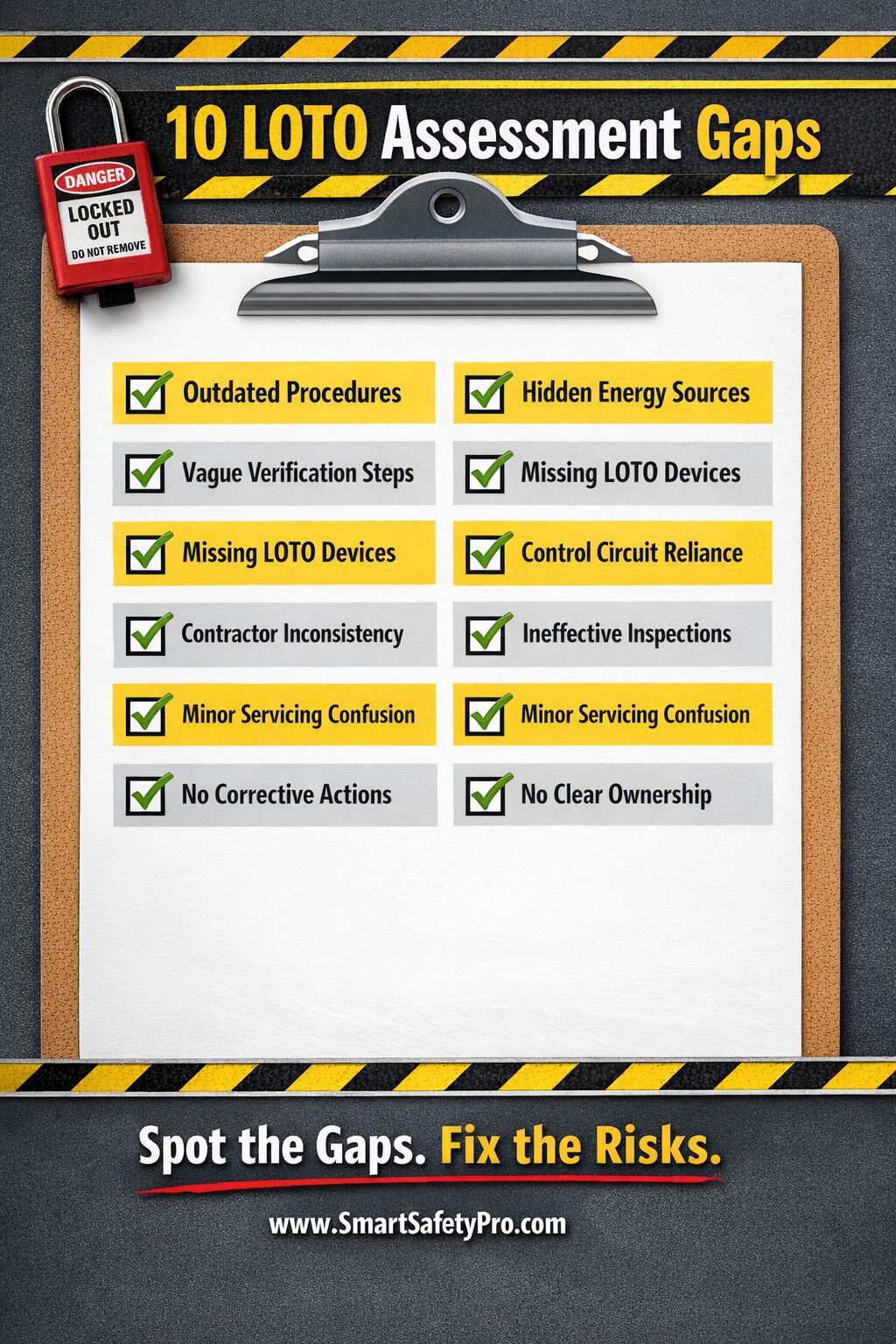
Below are 10 of the most common (and most overlooked) gaps that show up during a LOTO program assessment—plus simple ways to spot them in the field.
1) Procedures exist… but don’t match the machine
A procedure might be “technically present,” but if it doesn’t reflect current equipment configuration, it becomes a liability.
What to check:
-
Has the machine been modified since the procedure was written?
-
Are energy isolation points labeled the same way the procedure describes?
-
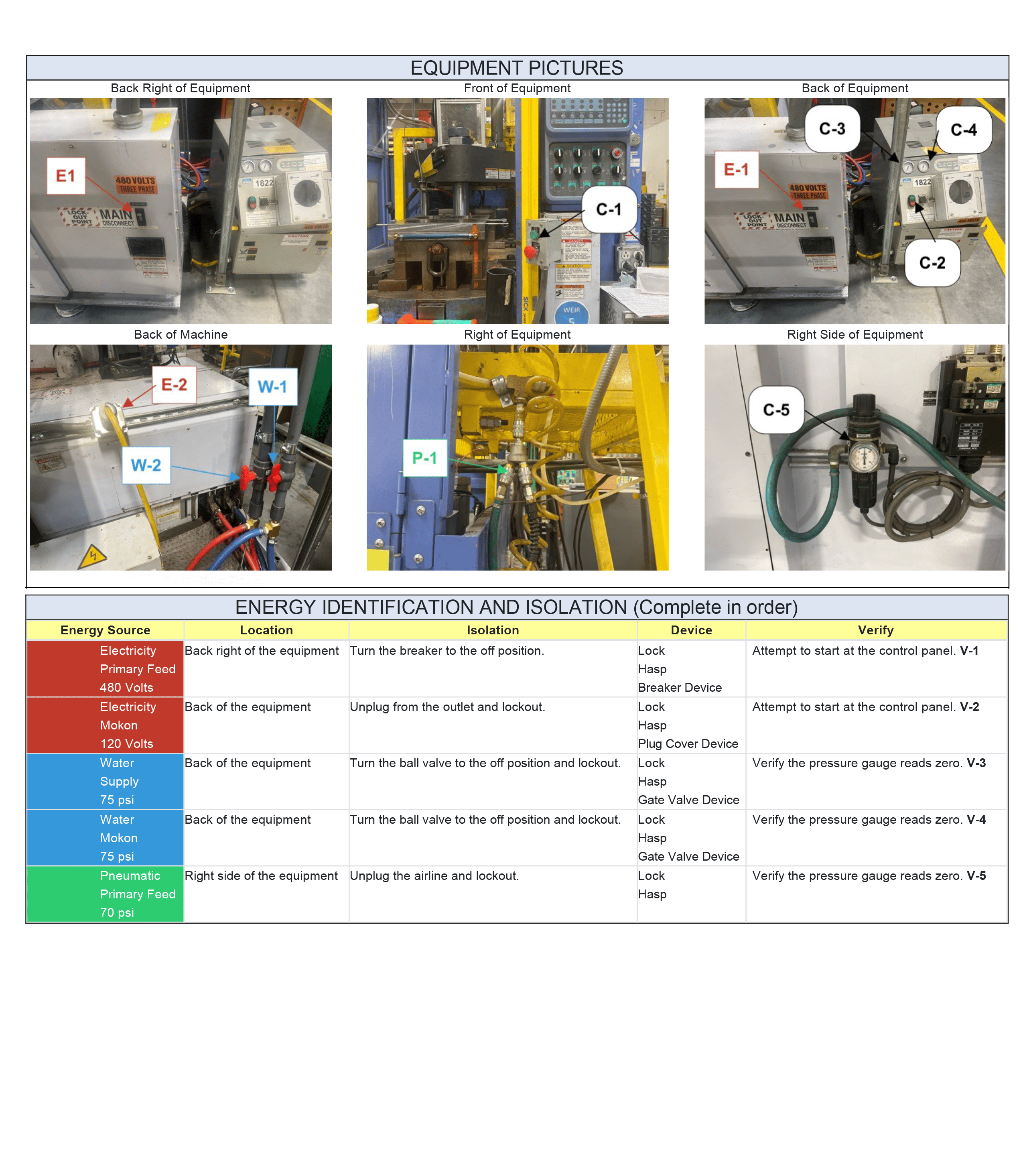
Do steps include all energy types (electrical, pneumatic, hydraulic, gravity, thermal, stored energy)?
Field test: Have a mechanic walk the written steps while you follow along—no coaching.
2) Stored energy isn’t addressed clearly
Stored energy is where “we locked it out” turns into “why did it move?”
What to check:
-
Bleed-down steps (air/hydraulic) are spelled out and verified
-
Blocking, pinning, or cribbing for gravity hazards
-
Capacitors, springs, counterweights, flywheels, and residual pressure addressed
A strong LOTO program assessment always includes stored-energy verification.
3) Verification steps are vague or skipped
Verification is the difference between “I think it’s safe” and “I know it’s safe.”
What to check:
-
Procedures include a specific verification method (try-start, test-for-zero, gauge reading, etc.)
-
Workers can explain what “zero energy” means for that system
-
Reset steps are included so try-start doesn’t create new risk
Red flag: “We verify by looking at it.”
4) Training doesn’t translate into behavior
Many facilities train annually but don’t validate competence.
What to check:
-
Are authorized employees evaluated doing actual lockouts?
-
Do people understand why steps matter, not just what the steps are?
-
Are supervisors reinforcing correct LOTO (or rewarding shortcuts)?
A LOTO program assessment should include observations—not just training records.
5) Locks and devices are missing at point-of-use
If employees have to “hunt for a lock,” they’re more likely to improvise.
What to check:
-
Adequate locks, tags, and devices stocked where work happens
-
Devices match real-world isolation points (valves, breakers, disconnects, pneumatics)
-
Standardization—so crews don’t carry five different “systems”
Simple fix: Point-of-use LOTO stations aligned to production areas.
6) People rely on control circuits instead of isolation
If someone says “I hit the stop button,” your assessment just found a major exposure.
What to check:
-
Lockout is performed at energy-isolating devices, not pushbuttons/HMI
-
Procedures reinforce isolation vs. shutdown
-
Supervisors and leads correct “control reliable” misunderstandings
7) Contractor LOTO is inconsistent
Contractor practices can vary wildly—especially on shutdowns.
What to check:
-
Clear contractor LOTO expectations and onboarding
-
Coordination rules for shared equipment
-
Control of keys, lock compatibility, and responsibility boundaries
A real LOTO program assessment includes contractor interfaces, not just internal crews.
8) Periodic inspections happen… but don’t improve anything
The inspection checkbox gets checked, but risks remain.
What to check:
-
Inspections include procedure accuracy + employee performance
-
Findings are tracked with owners and due dates
-
Repeat issues are treated as system failures (not individual blame)
If nothing changes after an audit, it wasn’t an audit—it was paperwork.
9) “Minor servicing” is misunderstood
This is one of the biggest sources of informal work and near misses.
What to check:
-
Clear definitions for servicing/maintenance vs. normal production operations
-
Documented alternative measures (if applicable) with real safeguards
-
Supervisors apply consistent criteria
If your crews debate this on the floor, your LOTO program assessment has a clear action item.
10) Program ownership is unclear
LOTO programs decay when no one owns updates.
What to check:
-
Named program owner (not just “EHS”)
-
Change management triggers (new equipment, modifications, incidents, near misses)
-
Procedure update workflow and version control
A Simple 10-Point LOTO Program Assessment Checklist (Start Here)
Use this as a fast screening tool:
-
Procedures match current equipment configuration
-
All energy sources identified (including secondary feeds)
-
Stored energy addressed with clear steps
-
Verification steps are specific and performed
-
Reset/return-to-service steps included
-
Hardware/devices available and standardized
-
Training includes hands-on competency checks
-
Periodic inspections create corrective actions
-
Contractor LOTO coordination is defined and practiced
-
Ownership/change management is documented
If you can’t confidently check a box, you’ve found a realistic improvement opportunity.
Want a Practical LOTO Program Assessment That’s Built for the Floor?
If you’d like a LOTO program assessment that goes beyond paperwork—focused on procedures, stored energy, verification, and real employee practices—Smart Safety Pro can help you identify gaps and prioritize fixes that are achievable without disrupting production.